
One beat.
Every machine.
PreciseSync gives every robot, camera and vehicle a shared wireless clock, so machines coordinate precisely, with less downtime and no new cabling.
An A*STAR spin-out, Singapore · Patent pending
A conveyor hands a part to a mobile robot. The clocks have drifted. The hand-off misses.
Plants are moving from fixed lines to mobile, collaborative production units on private 5G, and gaining around 20% in productivity. But a robot on 5G keeps time about 100× worse than one on a cable: every robot runs on its own crystal, and over wireless the data and the time it needs travel separately.
When a hand-off misses, the part is damaged and the floor is stopped and reset. In a large automotive plant one hour of unplanned downtime costs about US$2.3m. That is why manufacturers hesitate to cut the cable.
“Time synchronisation is a challenge in conveyor-to-AGV hand-offs.”Rockwell Automation, in our discussions. Designs the production lines. Not an endorsement.
In-motion hand-offs without a handshake: a 20–40% gain in their own use case.Cumucore, private-5G core vendor, September 2026. Their claim, their use case.
Time and data on one channel. Every robot in sync, and watched.
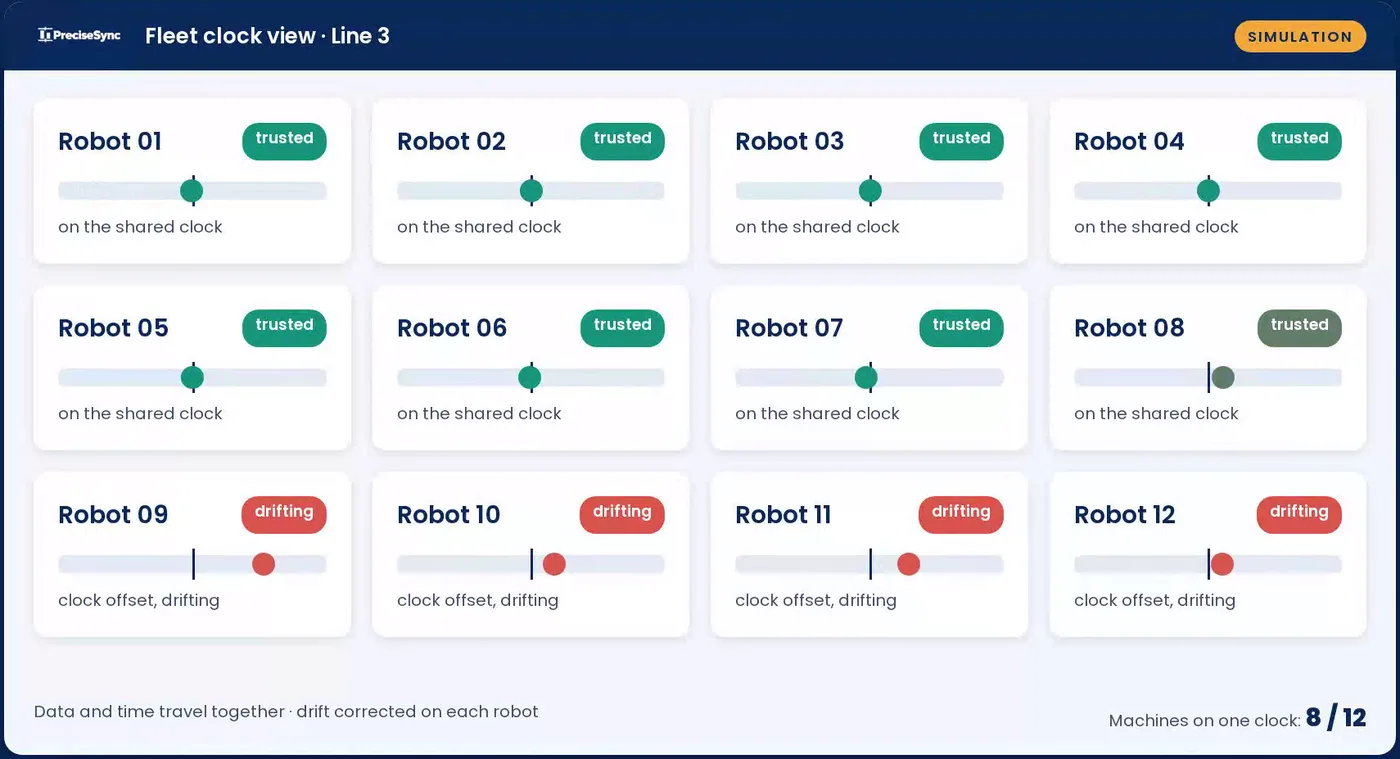
Software that runs in the robot's modem and on a shared master clock in the plant, with a portal for the people who run the floor.
Runs on the plant's own 5G
Time and data travel together over the private 5G network already in the plant. No new network, no new cables.
Measures the drift and corrects it
Each robot's clock is steered onto the plant's time, smoothly, so robot software never sees a jump. Staff are alerted before a robot drifts out of step.
A trust record per robot
Every hand-off is logged with its timing. The report shows which machines cause trouble, and why.
100× tighter, measured.
Lab measurements at A*STAR against a cable-grade PTP reference. Next step: the same measurement in a customer's plant.
Robot clock error on a private 5G network as delivered today.
Time and data over one modem on live wireless; drift corrected on the device.
Five years of research
Built and measured at A*STAR, Singapore, on live wireless. Two patent applications on file.
A paid pilot, A/B measured
Six months on one cell on the plant's private 5G. The line measured without PreciseSync, then with it. Hand-offs inside their window, drift-caused stops counted before and after.
The plant owner pays
One onboarding fee per site and a subscription per robot per year. Robot makers and 5G vendors carry PreciseSync into new plants.
Thirty years in wireless, manufacturing and sales.
Three co-founders, spun out of A*STAR after five years of research.

Dr Lars Henrik Skjolding
Serial entrepreneur; raised US$7.8m as co-founder and CTO of a venture-backed start-up. Semiconductor equipment. PhD physics.

Varun Goyal
Ten years in the wireless industry: Capgemini, HCLTech, Mavenir. Built the technology at A*STAR.

Jihad Alvaro
B2B sales: corporate banking and a cyber-security start-up. Leads sales and commercialisation.
A pilot 5G plant.
We are selecting design partners now: plants with mobile robots on private 5G, and the robot makers who supply them.
- A six-month pilot on one cell, measured before and after, with a trust record for every step.
- Advisors with manufacturing-automation and advanced-manufacturing expertise.
- Introductions to strategic investors with robotics, automation or manufacturing companies in their portfolio.
larshenrik@precisesynctechnologies.com
Singapore
Email Lars